Singularity Codex is a private message history with yourself. Send a thought, a task, a link, a photo — it lands permanently, at the moment you sent it.
There is no username to claim. There is no account, and no server to hold one.
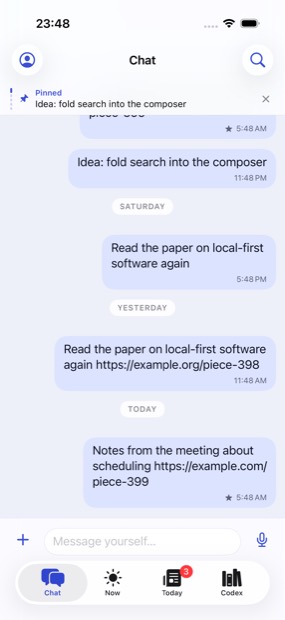
You never choose a notebook, a folder, a project or a tag before sending something. Time is the organising structure; everything else is derived from it. One attachment is one message, so a photo can be starred, replied to and found on its own.
See it label a sentence →
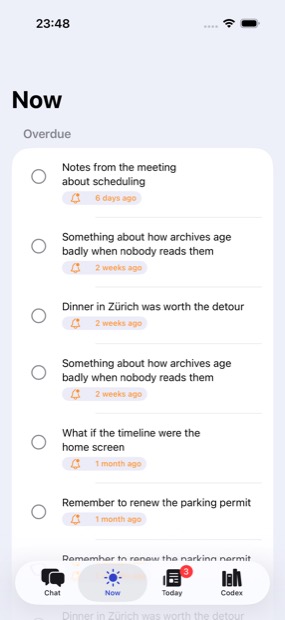
Reminders due, tasks still open, anything pinned, and the same date in earlier years. Three hundred neglected reminders are not “things worth responding to today”, so each section shows a handful and points at the rest.
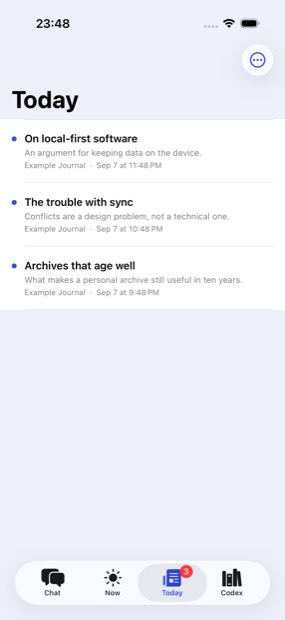
Subscribe by typing an address. Read what those sources publish, newest first. No ranking, no recommendations, no promotion, no engagement counts — you chose the sources and the sources decide what they publish. The absence is the feature.
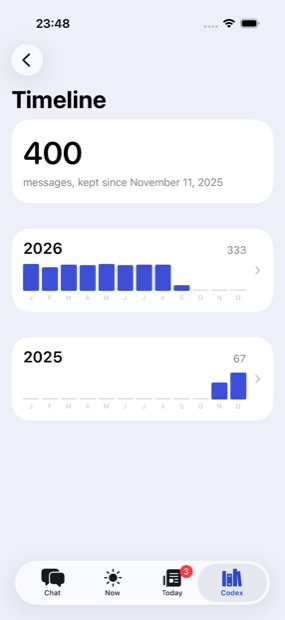
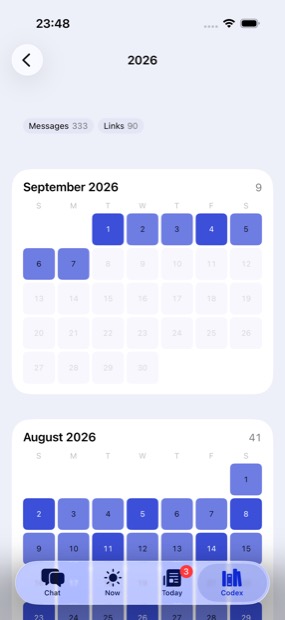
Twelve calendars say that this year started slowly and ran full through spring. Squares are shaded against that month’s own busiest day, so someone who writes three things a day and someone who writes three hundred each see their own rhythm.
Labelling runs on the phone’s own language models — never uploaded, never shown to anyone, and it never changes what you wrote. The same reading runs in this page. Type anything, in any of the languages below.
A notification cannot be trusted to wake anyone — the Silent switch, a Focus, a notification summary and one glance all defeat it. Codex hands the alarm to the system instead, so it rings through Silent, through a Focus, on the Lock Screen, with the app closed, and after it has been force-quit.
Refuse the permission and it says so plainly, then falls back to the loudest notification allowed — rather than claiming something it cannot do.
Not a policy — a shape. There is no server to send anything to.
Nothing to sign up for, nothing to sign in to, no identity to lose.
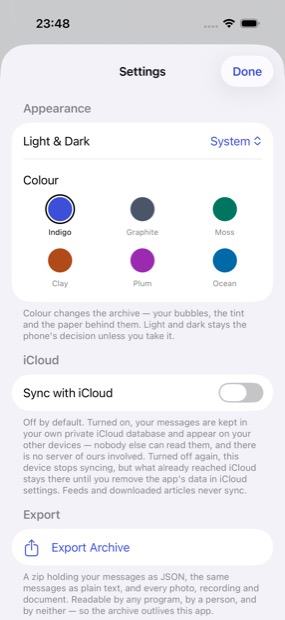
Messages live on the device, and — only if you switch it on — in your own private iCloud.
Worked out on device, never shown to anyone, and they never alter what you wrote.
Transcription is on-device or not at all. A recording is never uploaded to be read.
Fetching a feed you subscribed to, and asking a page you saved for its title.
A zip of JSON, the same messages as plain text, and every file — so it outlives the app.
Start where you are. The first message is the archive.
Still no username. Still no account.